Fluency and coherenceKeeping going, and making sense
Can you speak at length without long pauses, and can the listener follow you?
- Long turns without noticeable effort
- Hesitation and self-correction
- Discourse markers and connectives
IELTS Speaking is marked on four criteria with equal weighting: Fluency and coherence, Lexical resource, Grammatical range and accuracy, and Pronunciation, each from 0 to 9. Your Speaking band is their average, based on your performance across all three parts of an 11 to 14 minute test. For band 7 the descriptors ask for long turns without noticeable effort, flexible vocabulary with some less common words, and frequent error-free sentences.
From the ielts.org scoring page, format page and public band descriptors, checked 15 October 2026. Sources.
How a Speaking band is built
The same four criteria apply to every part of the test. Each carries equal weight, so each is a quarter of your Speaking band.
Can you speak at length without long pauses, and can the listener follow you?
Do you have the words for each topic, and can you paraphrase?
How varied are your sentences, and how often are they error-free?
How easily are you understood, and how well do you use stress, rhythm and intonation?
The test is a face-to-face interview, and it is recorded. You are rated on your average performance across all three parts, so every part counts.
The examiner checks your identity, then asks general questions on familiar topics such as home, family, work, studies or interests.
Tip: Answer, then add a reason or an example. One-word answers give nothing to mark.
You get a task card and one minute to prepare, with pencil and paper for notes, then talk for 2 minutes. The examiner stops you when time is up and may ask one or two questions.
Tip: Use the minute to note one idea per point on the card, so you can keep going for the full 2 minutes.
You and the examiner discuss issues linked to the Part 2 topic in a more general and abstract way.
Tip: Give an opinion, explain it, and compare views. This is where less common vocabulary shows.
Short paraphrases of the official public band descriptors. A band needs all of its positive features, so one weak criterion can hold the average down.
Band 7: the step most candidates are working onFull wording: Speaking band descriptors (PDF)
A transcript we wrote for the example task card above, with notes on each criterion. A band 6 answer often looks like this: it keeps going, but with repetition and a few basic slips.
Well, the place I’d like to talk about1 is a small park near my home. Um… I go there, I go there2 maybe three times in a week3, usually in the evening. There is a lake and many old trees, and I just walk around and listen to podcasts. The reason I like it / is because it’s very peaceful4, so it help me5 to relax after work. Actually, it’s kind of my little escape from the city noise6.
Example written for this guide, not a real candidate answer and not an app result. The slash marks where a speaker would pause between chunks.
Well, the place I’d like to talk about
A clear opening that signals the topic. Natural markers like this keep a long turn moving.
Um… I go there, I go there
Hesitation plus repetition. Band 6 says coherence may be lost at times this way; at band 7 it no longer affects coherence.
three times in a week
The usual collocation is “three times a week”. Band 7 shows an awareness of collocation.
The reason I like it / is because it’s very peaceful
Judged from sound, not text. Say each chunk as one group, with stress on PEACE-ful. Chunking and stress are band 6 to 8 features.
it help me
A basic error: “it helps me”. Band 7 allows a few basic errors, but error-free sentences should be frequent.
kind of my little escape from the city noise
Less common, idiomatic phrasing used naturally. This is what band 7 asks for.
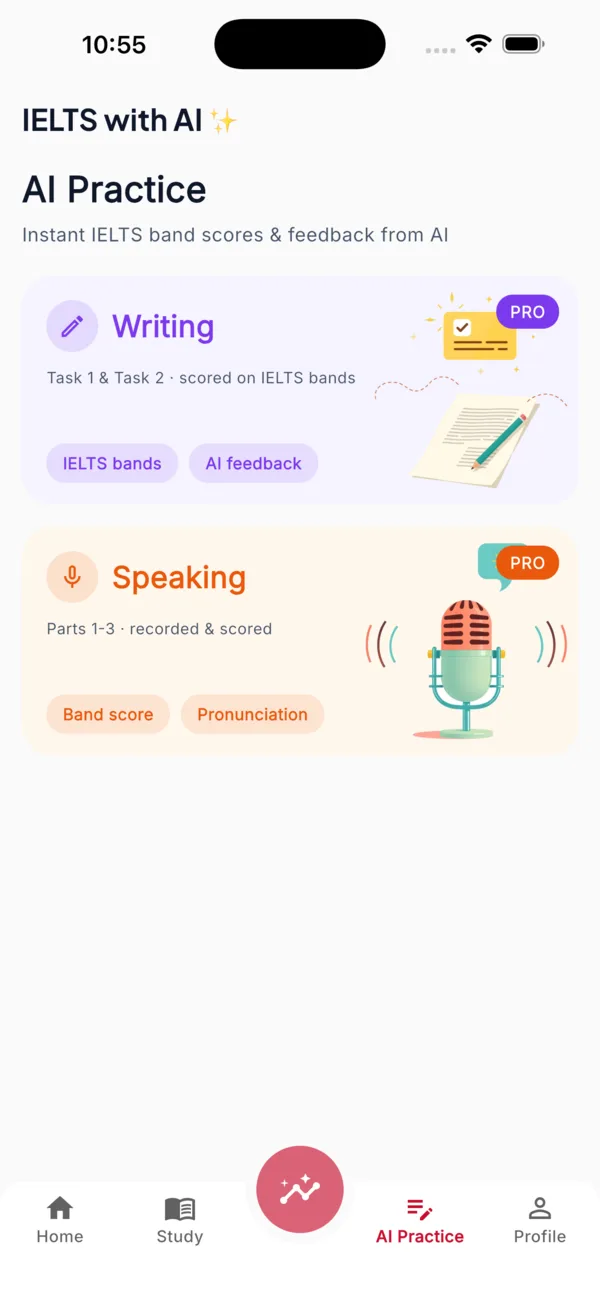
Pick a Part 1, 2 or 3 question in the AI Practice tab and record your answer. The app sends the recording itself, so Pronunciation is judged from your voice, not only from the words.

Well, the place I’d like to talk about is a small park near my home…
Every account gets one free AI Speaking try during setup. After that, AI scoring is part of Gold; limits reset at midnight UTC. The app scores one answer at a time, not the full test.
The AI band is a practice estimate. Only the IELTS test gives an official result.
An examiner gives a band from 0 to 9 on four criteria: Fluency and coherence, Lexical resource, Grammatical range and accuracy, and Pronunciation. The four carry equal weighting, and their average is your Speaking band. You are rated on your average performance across all three parts.
It takes 11 to 14 minutes and is face-to-face with an examiner. Part 1 lasts 4 to 5 minutes, Part 2 lasts 3 to 4 minutes including one minute to prepare, and Part 3 lasts 4 to 5 minutes.
You have one minute to prepare, with pencil and paper, then the examiner asks you to talk for 2 minutes and stops you when the time is up. They may ask one or two questions after that.
In the official descriptors, band 7 means: you keep going and produce long turns without noticeable effort; you use vocabulary flexibly, with some less common and idiomatic items; error-free sentences are frequent; and your pronunciation has all the positive features of band 6 and some of band 8.
The descriptors judge how easily you are understood and how you use stress, rhythm and intonation, not which accent you have. At band 8, accent has minimal effect on intelligibility.
It can estimate it if it listens to the recording itself rather than only a transcript. IELTS with AI sends your recorded answer, so Pronunciation is judged from the audio. The result is still a practice estimate, not an examiner’s band.
In IELTS with AI, every account gets one free AI Speaking try during setup. After that, AI Speaking scores are part of Gold, up to 3 a day.
No. It scores one answer at a time: a single Part 1, Part 2 or Part 3 answer. It does not run the full 11 to 14 minute test with an examiner.
Average your four section bands (Listening, Reading, Writing, Speaking) and round to the nearest half band: .25 rounds up to .5 and .75 rounds up to the next whole band. Our free band score calculator does this for you. Band score calculator →
Checked on 15 October 2026. Criterion names are quoted as ielts.org writes them; band wording is paraphrased.
IELTS with AI is an independent app, not affiliated with or endorsed by the IELTS test owners. AI band scores in the app are practice estimates.