IELTS with AIGuides
Official criteria, explained

IELTS Writing band score: how the 4 criteria are scored

Each IELTS Writing task is marked on four equally weighted criteria: Task achievement (Task 1) or Task response (Task 2), Coherence and cohesion, Lexical resource, and Grammatical range and accuracy, each from 0 to 9. The task score is the average of the four, and Task 2 counts more than Task 1. To move from band 6 to 7, the official descriptors ask for a clear, developed position, clear progression, some less common vocabulary and frequent error-free sentences.

From the ielts.org scoring page and public band descriptors, checked 15 October 2026. Sources.

How a Writing band is built

Task 1

TACCLRGRA

Task 2 counts more

Task responseCoherence and cohesionLexical resourceGrammatical range and accuracy
Writing band, in half bands0–9
The four criteria

What the examiner marks

The same four criteria apply to both tasks. Only the first one changes its name: Task achievement for Task 1, Task response for Task 2. Each one is a quarter of the task score.

Task achievement or Task responseTask achievement for Task 1, Task response for Task 2

Did you answer the question you were given, fully and relevantly?

  • Task 1: key features or bullet points covered
  • Task 2: every part of the prompt, a clear position
  • Ideas extended and supported
¼ of the task score

Coherence and cohesionHow the answer is organised and linked

Can the reader follow your ideas from start to finish?

  • Logical order and clear progression
  • Linking words, reference and substitution
  • Paragraphing
¼ of the task score

Lexical resourceVocabulary

How wide and how precise is your vocabulary?

  • Range and precision of word choice
  • Less common words and collocation
  • Spelling and word formation
¼ of the task score

Grammatical range and accuracyGrammar and punctuation

How varied and how accurate are your sentences?

  • Mix of simple and complex structures
  • How many sentences are error-free
  • Punctuation
¼ of the task score
Band 6 → 7 → 8

What changes between band 6, 7 and 8

Short paraphrases of the official public band descriptors. To get a band, your writing has to fit all the positive features of that band, so the lowest criterion often holds the task score down.

CriterionBand 6Band 7 the usual targetBand 8
Task achievement / Task response
Band 6: Main parts covered, some more fully than others. A relevant position, but conclusions may be unclear or repetitive; some ideas underdeveloped. Task 1: an overview is attempted.
Band 7: Main parts addressed appropriately. A clear and developed position; main ideas extended and supported, though they may over-generalise. Academic Task 1: a clear overview with the main trends or differences.
Band 8: The prompt is addressed appropriately and sufficiently. A clear, well-developed position; ideas relevant, well extended and supported.
Coherence and cohesion
Band 6: Generally coherent with a clear overall progression, but linking can be faulty or mechanical (misused, overused or missing). Paragraphing not always logical.
Band 7: Logically organised with clear progression throughout. A range of linking, including reference and substitution, used flexibly, with some over- or under-use.
Band 8: The message can be followed with ease. Ideas logically sequenced and cohesion well managed; paragraphing sufficient and appropriate.
Lexical resource
Band 6: Vocabulary is adequate; meaning is clear despite a restricted range or imprecise word choice. Some spelling or word-form errors that do not stop communication.
Band 7: Enough range for some flexibility and precision. Some less common or idiomatic words, awareness of style and collocation; only a few spelling errors.
Band 8: A wide range used fluently and flexibly for precise meaning. Skilful use of uncommon words; only occasional slips.
Grammatical range and accuracy
Band 6: A mix of simple and complex sentences with limited flexibility; complex structures are less accurate than simple ones. Errors rarely impede communication.
Band 7: A variety of complex structures with some flexibility and accuracy. Grammar and punctuation generally well controlled; error-free sentences are frequent.
Band 8: A wide range of structures used flexibly and accurately. The majority of sentences are error-free; punctuation well managed.

Band 7: the step most candidates are working onFull wording: Writing band descriptors (PDF)

Task 1 vs Task 2

Two tasks, 60 minutes, one Writing band

Academic and General Training share Task 2 and differ in Task 1. The timings are a guide: you manage the 60 minutes yourself, so spend the larger part on the task that counts more.

Academic Task 1

Task achievement

Describe visual information in your own words: a graph, table, chart or diagram.

Length
at least 150 words
Time
about 20 minutes

Tip: Band 7 needs a clear overview of the main trends or differences, not every number.

General Training Task 1

Task achievement

Write a letter about a given situation: personal, semi-formal or formal, covering three bullet points.

Length
at least 150 words
Time
about 20 minutes

Tip: Cover all three bullet points, with a clear purpose and a consistent tone.

Task 2, both modules

Task response · counts more

Write an essay in response to a point of view, argument or problem.

Length
at least 250 words
Time
about 40 minutes

Tip: Answer every part of the question and hold one clear position from start to end.

What costs you marks, per ielts.org

  • Off topic. Writing that does not relate to the topic is penalised.
  • Notes or bullet points. The answer must be connected text, not note form.
  • Copied text. Plagiarised writing is severely penalised, and copied words from the question are not counted.
  • Memorised phrases. Formulaic or memorised language is a feature of the low bands for Lexical resource.
  • Too short. A short answer may not show enough language for the higher bands. 20 words or fewer is rated band 1.
  • No overview (Academic Task 1). Listing details without the bigger picture is a band 5 feature; band 7 needs a clear overview.
Annotated example

One Task 2 paragraph, corrected line by line

An example we wrote for this page, with the kind of errors that keep Grammatical range and accuracy and Lexical resource at band 6. The layout follows the line-by-line review in IELTS with AI. Switch to Corrected to read the clean version.

Inline Review

Example Task 2 prompt: Some people think cars should be banned from city centres. To what extent do you agree or disagree?

In my opinion, banning cars from city centres have has1 many advantages. Firstly, the air become more cleaner becomes cleaner2 because there is less exhaust from traffic. For example example,3 in my city several street was several streets were4 closed to cars on sundays Sundays5 last year, and people could walk safety safely6. Secondly, shops in the centre can get more customers, so it is good for economy this benefits the local economy7.

A clear position and two relevant reasons. Most errors are agreement and word form, which hold back Grammatical range and accuracy.

Example written for this guide, not a real candidate answer and not an app result. The paragraph also leans on “Firstly” and “Secondly” only; band 6 calls that kind of linking mechanical, and band 7 asks for a wider range used flexibly.

CORRECTIONS · 7

  1. 1grammarGrammatical range and accuracy
    have → has

    The subject is “banning”, which is singular.

  2. 2grammarGrammatical range and accuracy
    become more cleaner → becomes cleaner

    One comparative form only, and “the air” takes “becomes”.

  3. 3punctuationGrammatical range and accuracy
    example → example,

    Put a comma after an opening phrase like “For example”.

  4. 4grammarGrammatical range and accuracy
    several street was → several streets were

    “Several” needs a plural noun and a plural verb.

  5. 5spellingLexical resource
    sundays → Sundays

    Days of the week take a capital letter.

  6. 6vocabularyLexical resource
    safety → safely

    A word-form error: the verb “walk” needs the adverb.

  7. 7styleLexical resource
    it is good for economy → this benefits the local economy

    More precise than “good for”, and “economy” needs “the”.

Check your Writing band

What an AI check in IELTS with AI gives you

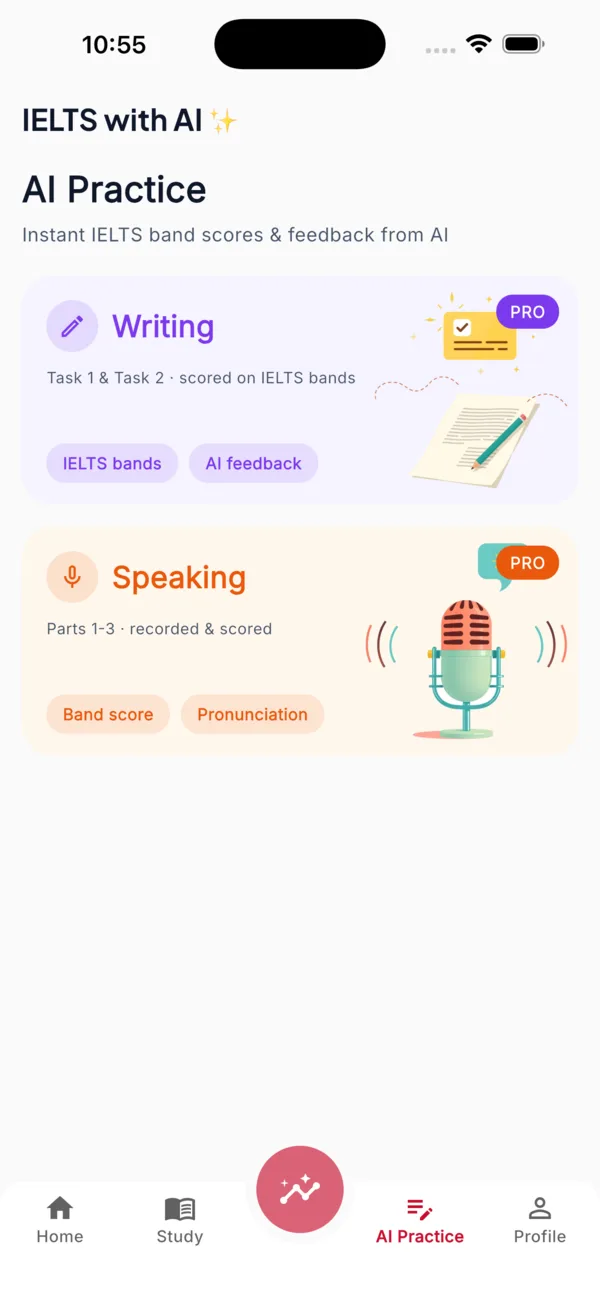
Write a Task 1 or Task 2 answer in the AI Practice tab and the app scores it on the four criteria, each from 0 to 9 in half bands, then averages them to the nearest half band.

AI Practice tab in IELTS with AI: Writing Task 1 and Task 2, scored on IELTS bands
AI Practice tab (screenshot)
Result screen (drawing, sample bands)
  • An overall band and four criterion bandsThe overall is the average of the four, rounded to the nearest half band, as in the test. The app names the first criterion Task Response for both tasks.
  • Strengths, areas to improve and next stepsShort bullets on what worked, what held the band down and what to practise next.
  • A model answer one band higherThe same task, written a level above yours, to compare.
  • A line-by-line reviewYour text with corrections marked grammar, vocabulary, style, spelling or punctuation, each with a short reason, like the example above.
3Writing scores a day
3Writing reviews a day
3Speaking scores a day

AI scoring is part of Gold. Limits reset at midnight UTC. There is no free AI Writing score; free users get one AI Speaking try during setup.

Not an official band

The AI band is a practice estimate. Only the IELTS test gives an official result.

Got your Writing band?Add Listening, Reading and Speaking to see your overall band.Band score calculator →
Download on the App StoreGet it on Google Play
FAQ

Common questions

How is IELTS Writing scored?

Each of the two tasks is marked on its own, on four criteria: Task achievement (Task 1) or Task response (Task 2), Coherence and cohesion, Lexical resource, and Grammatical range and accuracy. Each criterion gets a band from 0 to 9. The criteria are weighted equally and the task score is their average. Task 2 carries more weight than Task 1 in your Writing band.

Is Task 2 worth more than Task 1?

Yes. ielts.org says the assessment of Task 2 carries more weight in marking than Task 1. It is also longer: at least 250 words in about 40 minutes, against at least 150 words in about 20 minutes for Task 1.

What is the difference between Task achievement and Task response?

They are the first criterion of Task 1 and Task 2. Task achievement (Task 1) checks that you cover the key features of the visual information (Academic) or all three bullet points of the letter (General Training). Task response (Task 2) checks that you address every part of the prompt with a clear, developed position.

What do I need for band 7 in IELTS Writing?

In the official descriptors, band 7 means: a clear and developed position (Task 2) or a clear overview (Academic Task 1); logical organisation with clear progression throughout; enough vocabulary for some flexibility and precision, with some less common words; and a variety of complex structures, with frequent error-free sentences.

What happens if I write under 250 words in Task 2?

ielts.org says a short answer may not give enough evidence of the language needed for the higher bands. The descriptors rate any response of 20 words or fewer at band 1. Aim for at least 150 words in Task 1 and at least 250 in Task 2.

Can AI score IELTS Writing accurately?

An AI can estimate a band on the four criteria and point out errors, which is useful for practice. It is not an IELTS examiner, and no AI band is an official result. Use it to find your weakest criterion, then check again after you fix it.

Is there a free IELTS Writing checker in IELTS with AI?

No. AI Writing scores and the line-by-line review are part of Gold. Free users get one AI Speaking try during setup, plus the daily questions and study guides. Other apps and sites with free checks are compared in our best IELTS apps guide. Best IELTS apps →

How many essays can I check per day in IELTS with AI?

With Gold, up to 3 AI Writing scores and 3 line-by-line reviews a day. The limits reset at midnight UTC, and a check that fails does not count.

How do I work out my overall IELTS band?

Average your four section bands (Listening, Reading, Writing, Speaking) and round to the nearest half band: .25 rounds up to .5 and .75 rounds up to the next whole band. Our free band score calculator does this for you. Band score calculator →

Sources

Checked on 15 October 2026. Criterion names are quoted as ielts.org writes them; band wording is paraphrased.

  1. IELTS scoring in detail (ielts.org)The four Writing criteria and their names, “each task is assessed independently”, equal weighting of the criteria, the task score as their average, and “Task 2 carries more weight in marking than Task 1”.
  2. IELTS Writing band descriptors, Task 1 and Task 2 (ielts.org PDF, updated May 2023)Band 6, 7 and 8 wording paraphrased in the ladder, the overview requirement for Academic Task 1, memorised language, and “responses of 20 words or fewer are rated at Band 1”.
  3. IELTS Writing key assessment criteria (ielts.org PDF)Penalties for plagiarised scripts and for bullet points or note form.
  4. IELTS Academic Writing format (ielts.org)60 minutes, Task 1 visual information in at least 150 words in about 20 minutes, Task 2 at least 250 words in about 40 minutes, and the penalties for off-topic, note-form and plagiarised answers.
  5. IELTS General Training Writing format (ielts.org)Task 1 letter (personal, semi-formal or formal) with three bullet points, and the same timings and word counts.

IELTS with AI is an independent app, not affiliated with or endorsed by the IELTS test owners. AI band scores in the app are practice estimates.

← IELTS with AI home